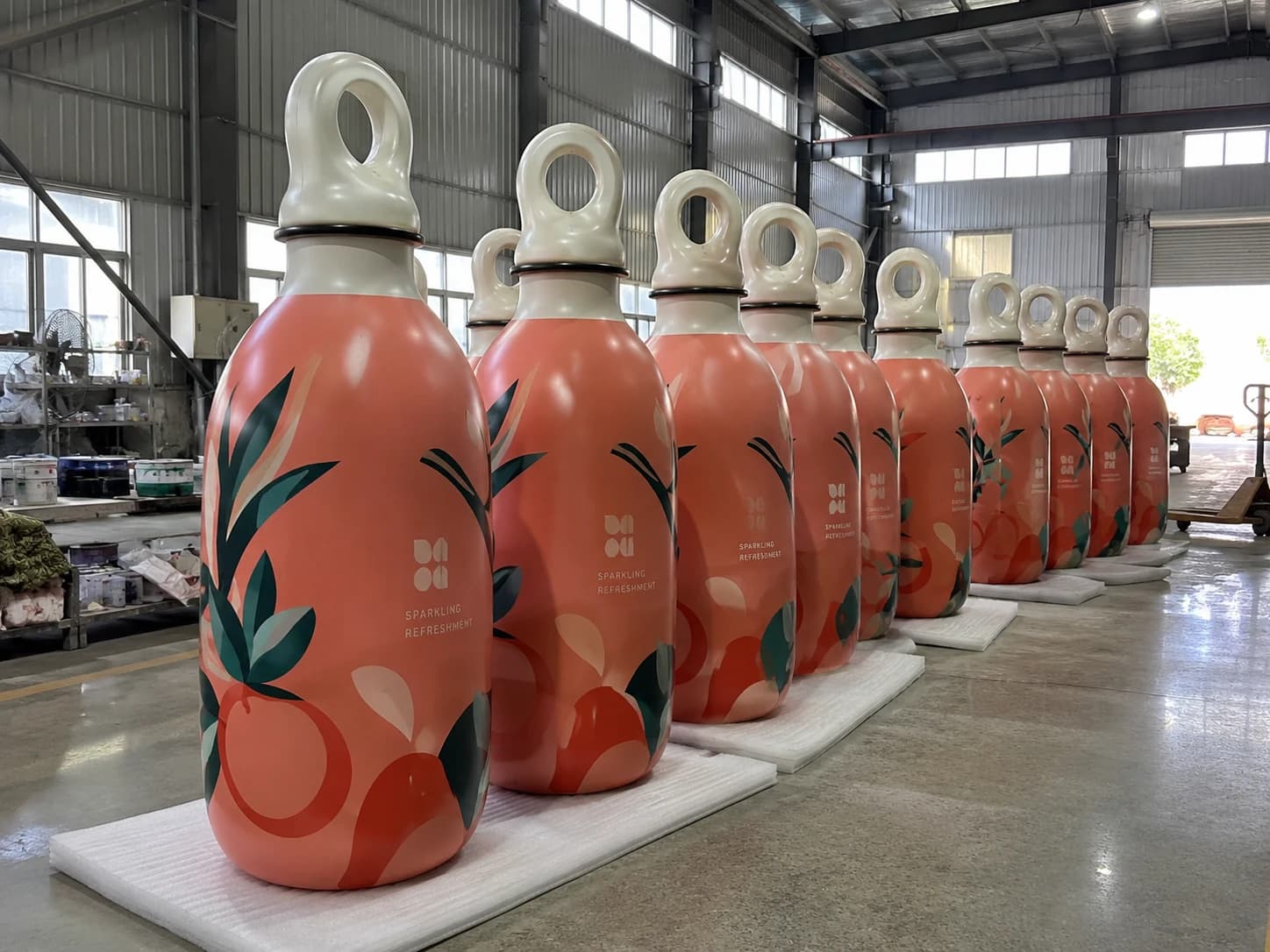
Producing one is not simply a matter of enlarging the original shape. The approved product reference has to be translated into a structure that can be fabricated, finished, transported and, where required, reproduced consistently across multiple units or locations.
YAVIS manufactures custom and oversized product replicas from client-approved designs, drawings, renders, 3D files or physical references, with the production process focused on structural execution, visual fidelity, finish control, repeat production and delivery preparation.
Start with an Approved Product Reference
Production begins with an approved reference.
Depending on the project, this may include:
- CAD or 3D files
- dimensioned drawings
- product renders
- high-resolution photographs
- branding artwork
- color references
- physical samples
The manufacturer’s role is to interpret the approved product accurately and determine how it can be translated into a practical production structure.
For simple forms, drawings and photographs may be enough. Products with complex geometry or tightly controlled proportions usually benefit from accurate 3D data.
Confirm Size, Use and Viewing Conditions
Scaling a product to display size changes how it needs to be made.
Key information normally includes:
- final dimensions
- quantity
- intended environment
- primary viewing angles
- indoor or outdoor use
- freestanding or fixed installation
- destination access
- handling requirements
A product replica used inside a retail store may require a different structure from one used at an exhibition or temporary activation.
Viewing distance also matters. Some small details become unnecessary at larger scale, while other features must remain very accurate because they define the product’s visual identity.
Translate the Product into a Production-Ready Structure
Once size and use are confirmed, the approved form has to be converted into something that can actually be fabricated.
This may involve decisions about:
- internal reinforcement
- shell construction
- base structure
- connection points
- detachable sections
- access panels
- assembly sequence
Large replicas are often divided into multiple parts when a one-piece structure would be difficult to produce, pack, transport or install.
Part breakdown therefore affects both manufacturing and logistics. The structure should keep visible seams under control while remaining practical to handle.
Select the Fabrication Method
The appropriate manufacturing method depends on the size, geometry, quantity, required finish and expected durability.
A commercial product replica may combine:
- fiberglass composite construction
- CNC-machined components
- 3D-printed patterns or parts
- internal metal reinforcement
- molded production
- fabricated panels
- mixed-material assemblies
The method should be selected around the project rather than around a single material.
A one-off display with complex geometry may require a different approach from a 20-unit or 50-unit retail rollout.
For repeat production, tooling, molds and standardized assembly methods become more important because the process has to reproduce the same result across the batch.
Control Visual Fidelity and Surface Finish
The finished replica needs to remain immediately recognizable as the approved product.
Important areas often include:
- overall silhouette
- relative proportions
- edge profiles
- openings and recesses
- logo position
- graphic placement
- color separation
- surface finish
Depending on the original product, the required finish may include:
- high-gloss paint
- matte or satin surfaces
- metallic effects
- printed graphics
- applied logos
- decals
- textures
- transparent or semi-transparent elements
Color references may be supplied through Pantone, RAL, physical samples or approved artwork.
For branded displays, visual recognition and finish consistency are usually more important than reproducing every minor detail.
Use First-Unit Approval for Multi-Unit Production
Producing one successful replica and producing many consistent replicas are different challenges.
For multi-unit projects, the first completed unit can serve as the production reference.
The review may include:
- overall proportion
- dimensions
- structural stability
- branding
- color
- surface finish
- assembly
- visible seams
Once approved, that unit provides a practical benchmark for the remaining production run.
Repeat production then requires control of:
- molds or production references
- component fit
- color formulas
- finishing procedures
- branding placement
- assembly sequence
- batch QC
For retail and brand rollout projects, consistency across the batch is often as important as the quality of any single piece.
Plan Packing and Rollout Preparation Early
Packing should be considered before the replica is finished.
Oversized forms may include projections, narrow sections, gloss surfaces or branded details that are vulnerable during transportation.
Production planning may therefore need to account for:
- detachable parts
- protected corners
- surface protection
- foam or cushioning
- internal support
- wooden crates
- labeling
- assembly references
A modular structure can sometimes reduce packing volume and transportation risk, but unnecessary disassembly can also increase installation complexity.
The right approach balances manufacturing, shipping and final assembly.
Before shipment, completed units may be checked for dimensions, structural stability, surface quality, branding placement, assembly fit and packing readiness.
From Approved Product Reference to Commercial Display
Oversized product replicas combine visual replication with practical manufacturing.
A successful project depends on accurate reference material, appropriate structural planning, suitable fabrication methods, controlled finishing, repeat-production discipline and packing preparation.
For one-off displays, the priority may be accurate execution of a single approved form.
For retail rollouts and brand activations, the challenge extends to maintaining the same appearance across multiple replicas while keeping production, packing and deployment practical.
YAVIS manufactures custom and oversized product replicas for commercial display projects based on client-approved designs and references.